FREE SHIPPING OVER $200

Journal · Intuition & Rituals
The Evidence Journal
A crystal-and-card ritual for listening to intuition without treating it as certainty.
Quick answer
The Evidence Journal pairs one stone with one image card to separate what is visibly present, what the image personally evokes, and what is known about its source. It is an observation practice for reading images more carefully—never a prediction or verdict.
A slower way to read an image
Evidence journal: observation is not the same as interpretation.
A raised hand can become rejection; a doorway can become opportunity; a dark sky can become danger.
Those readings may be personally meaningful, but they are not the same as the visible details on the card. The journal records where seeing ends and association begins.
Gather four simple things
Your ritual materials
01
One stone
Choose a smooth crystal that feels comfortable to hold. Its job is to anchor attention.
02
One image
A tarot card, oracle card, art card, or photograph—anything rich enough to notice.
03
A notebook
One page, one pen, and three clearly drawn columns.
04
Twelve minutes
A short boundary keeps reflection from becoming rumination.
Prepare the image-evidence page
Make three columns before you begin
Keep visible detail, personal association, and documented context in their own places.
Column one
Visible detail
What could another viewer point to in the image?
Column two
Association
What memory, mood, or story does this evoke for me?
Column three
Known context
What do the title, artist, deck guide, date, or source say?
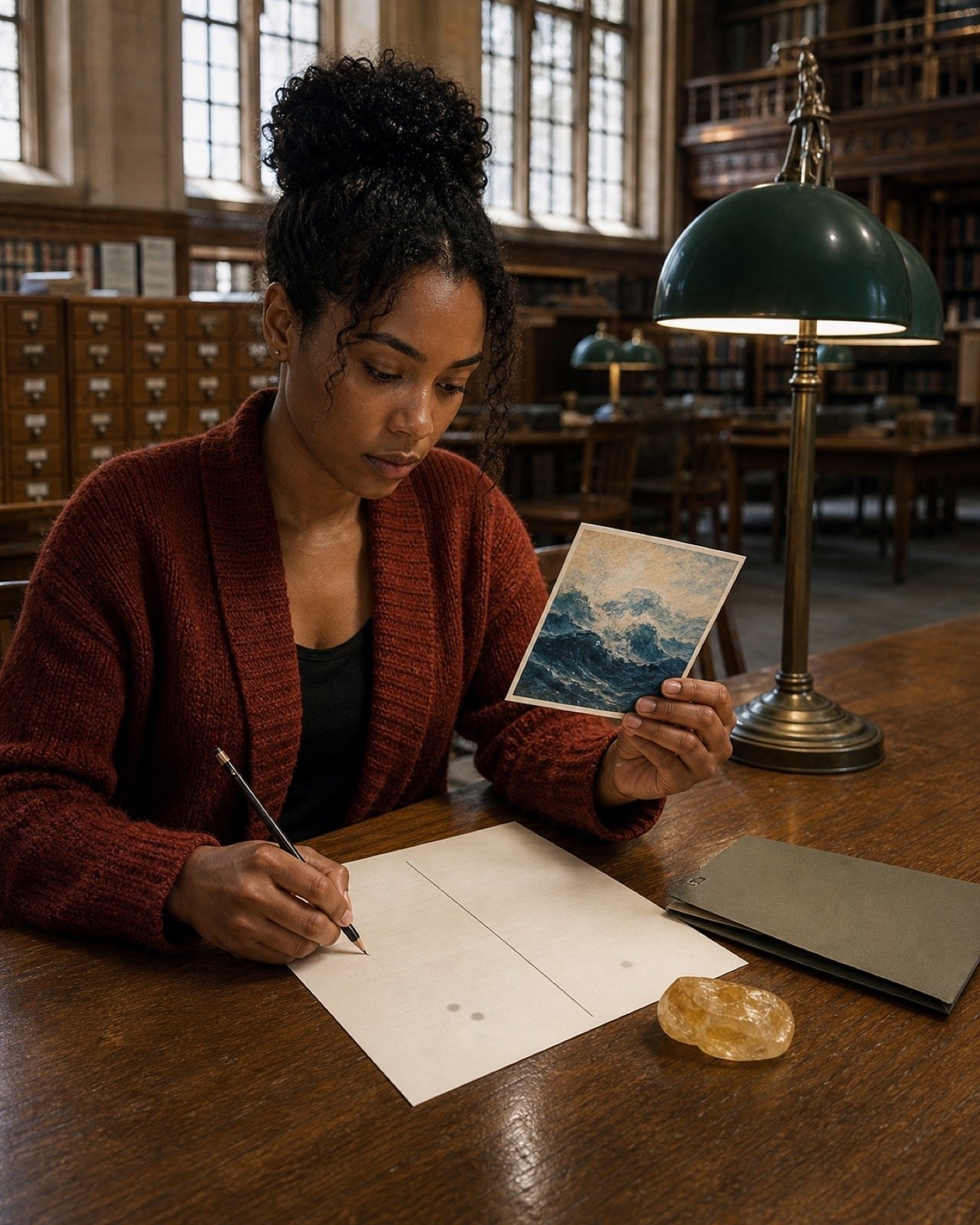
The grounding principle
Look again before you name the meaning.
Write the colour, gesture, object, weather, and direction before adding words such as lonely, lucky, blocked, or hopeful.
No verdicts on the first page.
A documented reading can remain meaningful without becoming an instruction.
The 12-minute ritual
From visible detail to documented reading
Minutes 1–2
Set an observation question
Ask “Which detail did I overlook at first?” rather than asking the image to predict an outcome.
Minutes 3–4
Choose one image
Name three things you can locate—colour, gesture, weather, distance, or direction.
Minutes 5–7
Describe before interpreting
Write only visible details in the first column.
I can point to…
Minutes 8–10
Record the association
Complete “This reminds me of…” and “I may emphasize it because…”
Minutes 11–12
Add available context
Check only the title, artist, guidebook, caption, or source note already available.
A useful distinction
Three layers can coexist without becoming the same thing.
A personal association does not become false because it is subjective. It simply belongs in a different place from a visible feature or a documented source.
OBSERVED — A detail another viewer can locate.
ASSOCIATED — A memory or meaning you brought to the image.
CONTEXTUAL — Information supplied by the artist, deck, caption, or collection.
Return after 24 hours
See how interpretation moved.
Come back without holding the stone. Underline one observation, circle one association, and box one piece of source context.
- Which detail is still easy to locate?
- Which association changed overnight?
- Did source context widen or narrow the reading?
- Does yesterday’s meaning still seem inevitable?
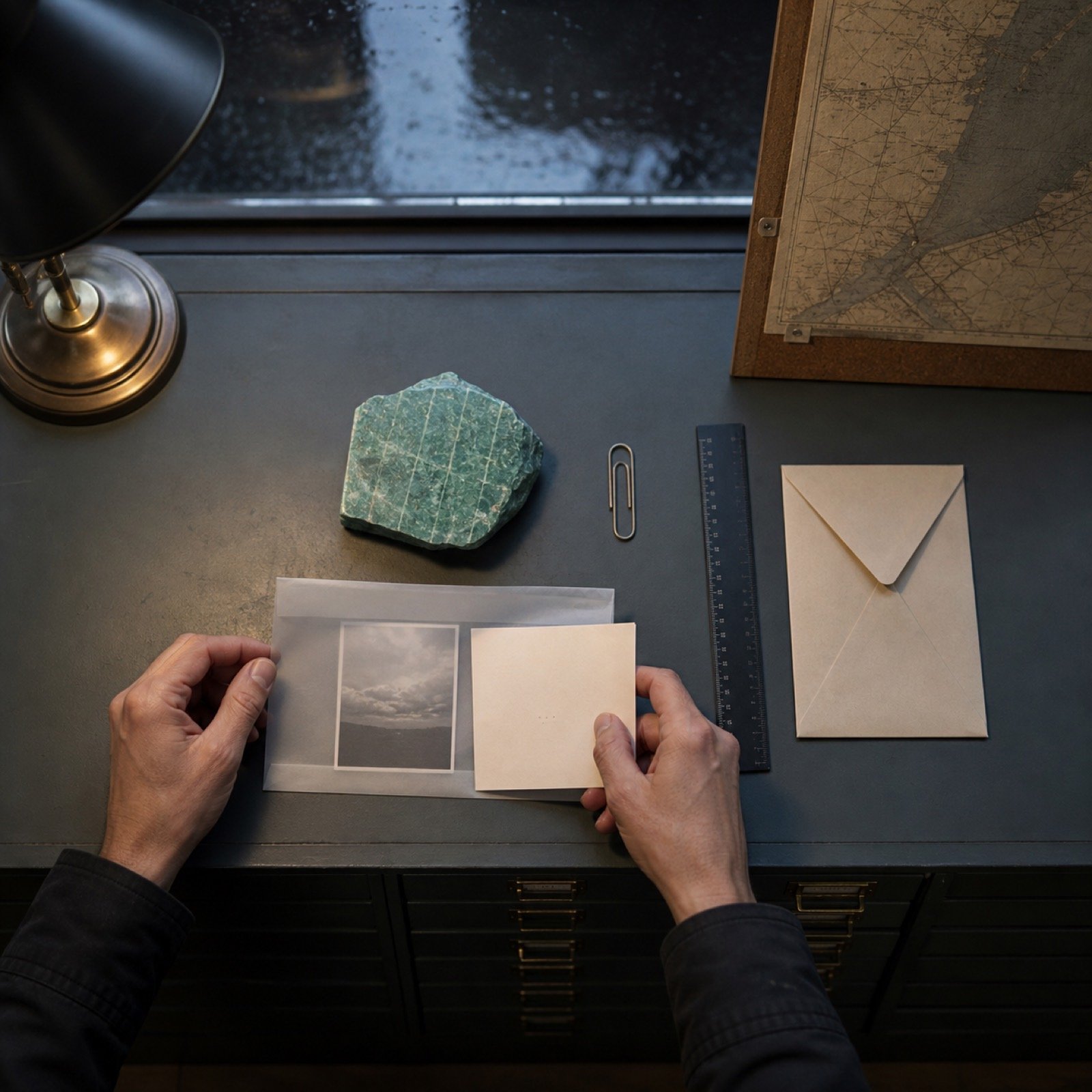
An image is a prompt, not an authority.
Do not use this practice to diagnose illness, confirm danger, read another person’s mind, or make high-stakes financial and legal decisions.
Its value is narrower and more useful: it trains careful description, makes personal associations visible, and preserves source context.
Common questions
Before you begin
Do I need a special crystal?
No. Use a stable object that will not scratch the card or roll across the page. Its job is to slow the pace of looking.
Can I do it without tarot?
Yes. Use a postcard, artwork, photograph, or a page from a nature book. The method depends on observation, not a particular deck.
What if the ritual makes me more anxious?
Stop, put the materials away, and orient to the room. Choose a simple grounding action or speak with someone you trust.
Source note: informed by Ember Grant’s use of cards as prompts for self-questioning. The visible-detail–association–context framework is original editorial work. For responsible information about mineral names and reference images, consult the Mindat mineral database; browse practical objects in the Himalayan Ritual shop.
An evidence journal works best when it separates observation from association. Write what you can point to, note what it brings to mind, then record any caption or source you can check. This keeps the practice reflective without turning an image or crystal into an authority.