FREE SHIPPING OVER $200

JOURNAL · INTENTIONS & RITUALS
The Sand Ledger
A CRYSTAL RITUAL FOR LETTING GO WITHOUT THROWING ANYTHING AWAY · UPDATED AUGUST 26, 2026
QUICK ANSWER
Sand ledger ritual: use a tray of clean decorative sand, one small stone, and a written list to mark what is changing. Make a temporary pattern, record what you learned, and reuse every physical component.
Letting go is often pictured as a dramatic act: a letter burned, an object buried, a cord cut. But many transitions are quieter. You may not want to erase a relationship, habit, job, or version of yourself. You may simply need to stop carrying it in the same way.
Sand is well suited to this kind of practice because it is movable, revisable, and temporary. A stone gives the ritual one stable point; the sand makes room for change around it.
Sand ledger ritual: why use sand and a stone together?
The pairing creates a useful contrast. This is not a claim that sand absorbs negativity. It is a physical metaphor that gives your hands something to do while your mind becomes more specific.
≈
Sand
Represents the parts of life that can be rearranged: routines, stories, expectations, and next steps.
◆
A stone
Represents the part you choose to keep: a value, lesson, boundary, or memory.
MATERIALS & SAFETY
Everything returns to its place.
- A shallow tray or plate with a rim
- Clean decorative, landscape, or craft sand
- One small tumbled stone or pebble
- Scrap paper and pen
- A jar or sealed bag for storing the sand
Do not collect sand from protected beaches, cultural sites, or sensitive habitats. Do not wash sand down a sink. If you use candles or incense, keep them separate from the sand; the ritual works without flame.
A SIX-PART REFLECTIVE PRACTICE
The Sand Ledger ritual
Make one temporary pattern, then preserve only the part that matters: a clear next action.
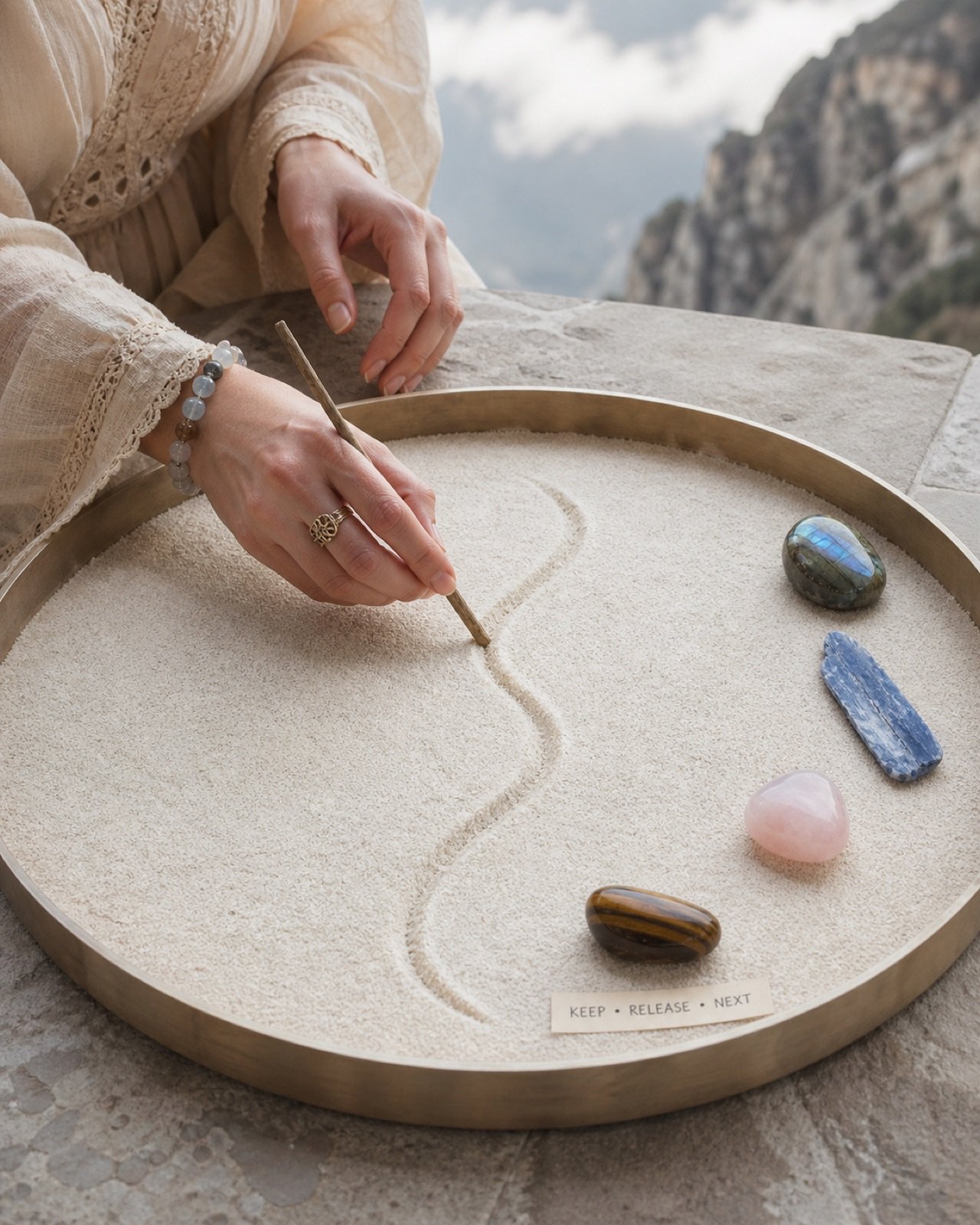
KEEP · RELEASE · TRY NEXT
A pattern does not need to last in order to matter.
Let the sand carry the revision. Let the ledger carry the lesson.
01
NAME
Name the transition in one neutral line
“Something is changing in the way I…”
Finish the sentence with observable language. “Work late,” “speak to myself,” or “hold onto this plan” is more useful than “fix my life.”
02
ANCHOR
Place the stone in the center
Choose one word for what stays: rest, honesty, friendship, skill, home, or courage. You do not have to believe the stone contains the quality. Let it stand in for that quality because you chose it.
03
ARRANGE
Draw three rings in the sand
Label them on your paper, not in the sand:
- Keep — what remains valuable.
- Release — what no longer needs daily attention.
- Try next — one small experiment for the coming week.
Place a tiny mark in each ring. It can be a line, dot, or short word if the sand is coarse enough.
04
REVISE
Change the pattern deliberately
Smooth away one ring—not all of them—then draw a new line leading outward from the center stone. This is your next experiment: decline one optional commitment, move a task to tomorrow, ask for information, or take a walk before deciding.

05
RECORD
Make the ledger entry
- “I am keeping…”
- “I am loosening my grip on…”
- “For seven days, I will test…”
The written entry is the durable part. The sand pattern can disappear without carrying the burden of being perfect.
06
REUSE
Return the materials
Pour the sand into its storage jar and keep the stone near your ledger for one week. At the end of the week, read what you wrote and decide whether to repeat the practice. You are not discarding the past; you are choosing what deserves current energy.
A QUIET CORRECTION
Make it less aesthetic, more honest.
Use ordinary sand. Let the circles be uneven. Do not photograph it if sharing would turn the experience into a display. The goal is a clearer next action, not a perfect altar.
THE LEDGER STAYS; THE PATTERN MOVES
You are not discarding the past.
You are choosing what deserves current energy. Keep the lesson, loosen the grip, and test one small next step.
QUESTIONS, PLAINLY ANSWERED
FAQ
Can I use beach sand?
Purchased craft or landscape sand is better. Beach sand can be contaminated, ecologically important, or subject to collection rules.
What crystal is best for letting go?
Choose a stone whose color, texture, or personal history feels steady to you. There is no objectively correct choice.
Do I have to destroy the pattern?
No. Smooth only one part of it, then reuse the sand. The point is revision, not destruction.
Source note
This original low-waste reflective practice is conceptually informed by Ember Grant’s discussion of sand as a temporary, reusable material and by her attention to impermanence. For mineral names and reference images, consult the Mindat mineral database; browse tactile objects in the Himalayan Ritual shop.
A sand ledger ritual is a short, low-waste reflection: make a temporary pattern, write what changes, and reuse the materials. The steps, wording, and “Sand Ledger” framework are new.
Source: Grant, Ember. The Book of Crystal Spells: Magical Uses for Stones, Crystals, Minerals … and Even Sand. Llewellyn Publications, 2013, chapter 5, “Sand and Glass Spells.”
Editorial note: This is a contemplative exercise, not a treatment for grief, trauma, anxiety, or any health condition.
CONTINUE YOUR RITUAL
Choose one object worth returning to.
A quiet anchor can make the next step easier to remember.