FREE SHIPPING OVER $200

Journal · Intentions & Rituals
The Chalcedony Field Notebook
Chalcedony is less a single look than a family resemblance. Some pieces show translucent bands; others hold moss-like inclusions, fossil-like circles, soft clouding, or dense earth-toned patterns.
Jasper is generally more opaque and pictorial; carnelian often carries a more luminous orange-to-red range. That variety makes this group especially good for an article about attention: a stone can be looked at repeatedly without ever looking exactly the same.
What is a chalcedony ritual?
A chalcedony ritual is a symbolic practice built around the appearance of microcrystalline quartz stones such as agate, jasper, and carnelian. Instead of asking a stone to solve a problem, use its banding, inclusions, and opacity to organize reflection. The result should be one clearer observation and one concrete choice.
◎
Look before interpreting
Start with color, line, density, and light. The stone gives your attention somewhere specific to rest.
→
End with an action
A written observation becomes useful when it leads to one boundary or one task small enough to complete.
Choose three distinct forms
The visual contrast is part of the practice. Select stones with clearly different surfaces and silhouettes—not three versions of the same stone.
| Role | Suggested material | What to notice | Journal prompt |
|---|---|---|---|
| The Pattern | Moss, dendritic, blue lace, crazy lace, or picture agate | Lines, inclusions, bands, windows | What pattern keeps returning? |
| The Ground | Picture, red, leopard, ocean, or landscape jasper | Density, speckle, earth tones | What is true even when the day is noisy? |
| The Spark | Carnelian or carnelian agate | Warmth, translucency, shift of color | What small action deserves energy? |
Five days · Five minutes each
The chalcedony field notebook ritual
You need only three pieces, a notebook, and five minutes a day. Looking comes first; interpretation stays modest; every day closes with language you can use.
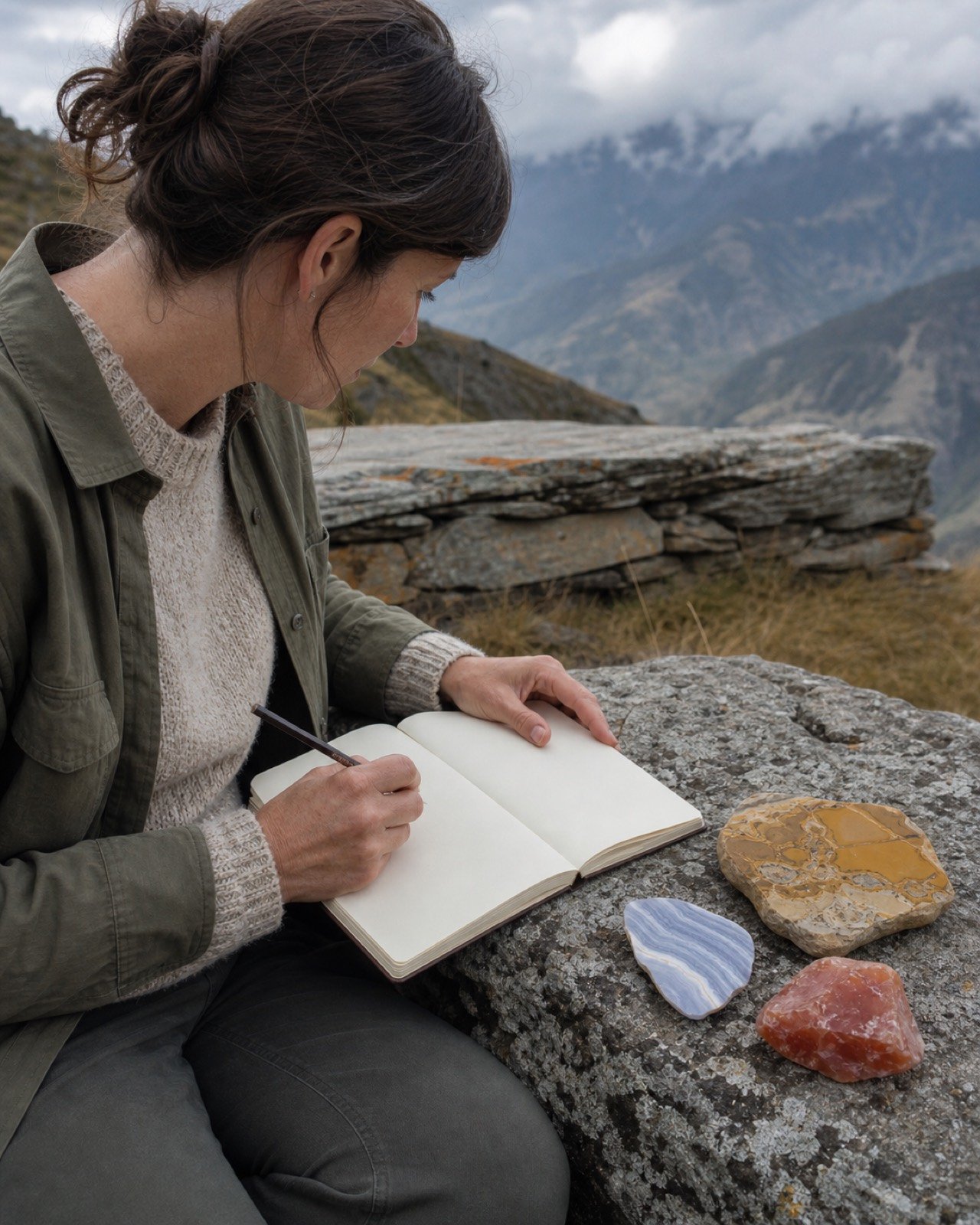
A practice of attention
Let the stone slow the first sentence.
Do not search for a hidden message. Describe what is actually in front of you, then decide what deserves a response.
01Pattern
Map the pattern
Place the agate in morning light or beside a lamp. Sketch the most visible line, patch, band, or inclusion in your notebook.
“This week, I keep noticing…”
Finish with something observable: a request you postpone, a thought that returns, a moment of ease, or a habit that costs more energy than expected.
02Ground
Name the ground
Hold or place the jasper on the page. Write two short lists: three resources, facts, or people that are genuinely available; then one issue you can acknowledge without carrying all day.
Choose a boundary small enough to practice: close the work tab at a set time, stop revising a message after two drafts, or postpone a non-urgent decision until you have information.
03Spark
Give the spark a job
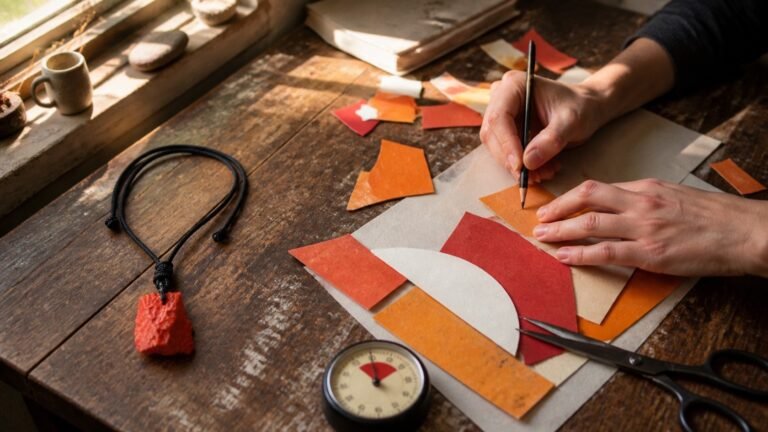
Put the carnelian beside a task that needs movement.
“For 20 minutes, I will begin by…”
When the timer ends, record what changed. Useful outcomes include gaining information, making the task smaller, or discovering that you need help.
04Compare
Compare the surfaces
Arrange all three stones in a loose line: agate, jasper, carnelian. Look for contrast rather than correspondence—translucent and opaque, branching and compact, cool and warm.
- The pattern I am ready to see is…
- The ground I want to protect is…
- The spark I can responsibly act on is…
05Carry
Make a carry card
Choose the one stone you are most drawn to after four days. Place it on a small card and write a six-word reminder. Keep the stone at a desk, in a pocket, or beside a journal for one week.
The card is the practical object of the ritual. The stone gives it a visible home.
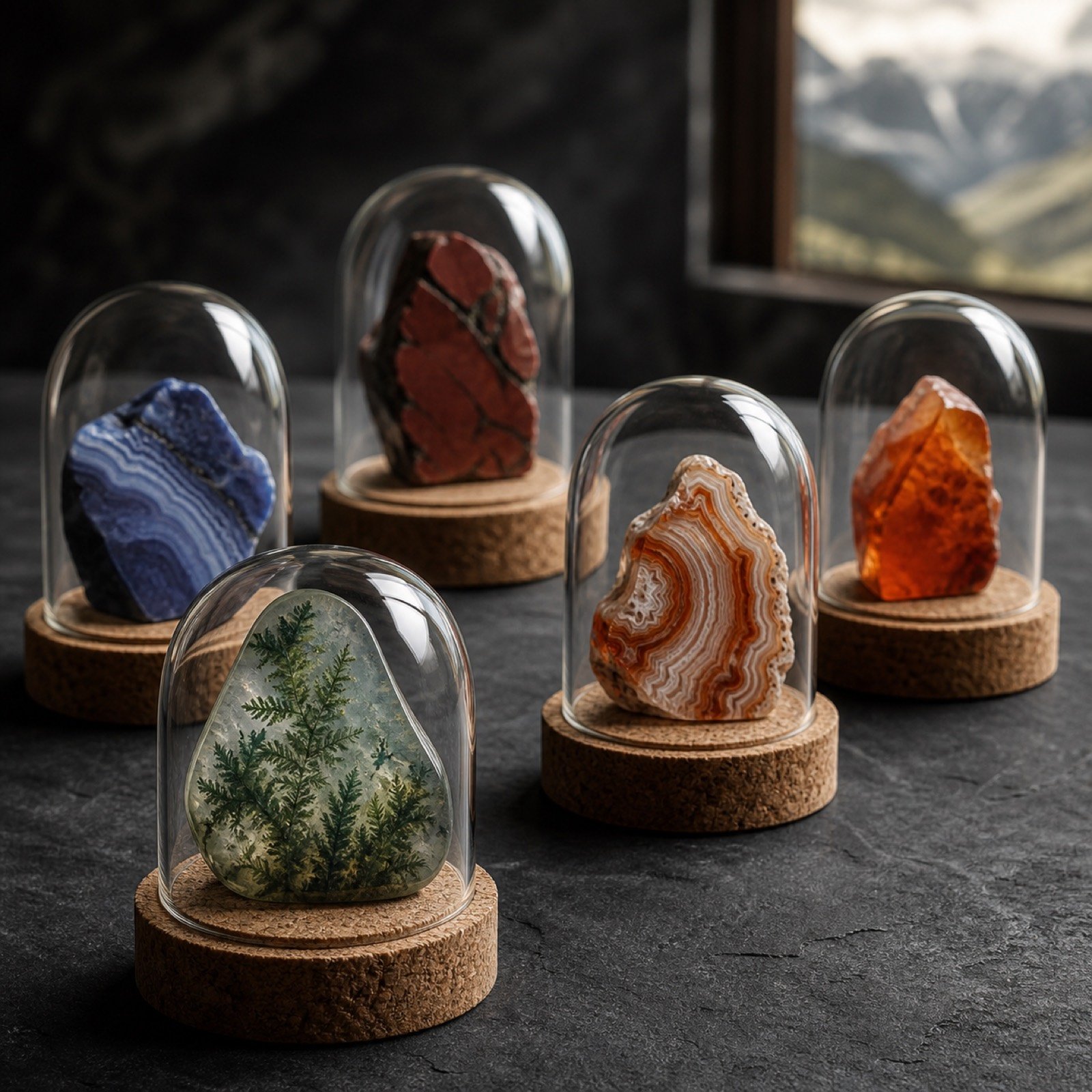
Texture over trend
Style a collection without making it generic
The strongest grouping is based on texture and form, not an all-beige palette.
- A translucent blue lace agate slice
- A rough red jasper chunk
- A polished moss agate freeform
- A naturally patterned picture jasper
- One luminous carnelian palm stone
A small mineral stand or low stone tray can keep the variation visible. Choose each piece for its material qualities, not a promised result.
Material care
Keep the routine simple.
Most polished pieces benefit from dry dusting and a soft cloth. Keep dyed agates away from prolonged direct sun, and do not assume that every vividly colored agate is naturally colored. When in doubt, ask the seller about treatment and use gentle, material-appropriate care.
Questions, plainly answered
FAQ
Is carnelian part of the chalcedony family?
Carnelian is generally described as a red-to-orange variety of chalcedony. Appearance ranges from more translucent to more opaque, and some commercial pieces may be treated to enhance color.
What is the difference between agate and jasper?
Agate is usually translucent to semi-transparent and may show bands or inclusions. Jasper is typically more opaque and often appears mottled, spotted, or landscape-like.
Can I do this ritual with one stone?
Yes. Use one agate, jasper, or carnelian piece across three days: pattern, ground, and spark. The written observations matter more than owning a complete set.
Source note
This is an original five-day reflective practice. For mineral names and reference images, consult the Mindat mineral database; browse tactile objects for reflective writing in the Himalayan Ritual shop.
A chalcedony ritual works best as a short observation practice: describe a stone, record a boundary, and choose one manageable action. The ritual supports reflection rather than promising a result.
It draws contextual inspiration from Ember Grant’s discussion of the chalcedony group. The field-notebook framework, prompts, structure, product applications, and wording are new.
Source: Grant, Ember. The Second Book of Crystal Spells: More Magical Uses for Stones, Crystals, Minerals … and Even Salt. Llewellyn Publications, 2016, chapter 6.
Editorial note: This is a symbolic, reflective practice. It is not medical, mental-health, or financial advice.
Continue your field notes
Choose one surface worth a second look.
Begin with what you can see. Let the page hold the pattern, the boundary, and the next practical step.
Explore agate & chalcedony